

Website visitor identification helps UK businesses understand which known
individuals, companies, or consenting households are showing an interest in
what they offer.
There’s no single tool that reveals the name of every anonymous visitor to
your site. Instead, businesses typically combine up to three separate
approaches:
- Known individuals – recognising people who’ve already shared their
details with you, through a form, account, or purchase - Companies – identifying organisations visiting from business networks,
using IP-matching technology - Households – identifying consenting visitors at home-address level,
most useful for consumer-facing businesses
Each method works differently, reveals something different, and comes with
its own accuracy rate, cost, and legal considerations – all compared in
detail below.
(For a broader look at what any ordinary website can see about a visitor from a privacy perspective, see our UK website tracking and privacy guide.)
Within this guide we explain the three main levels of website visitor identification used by UK businesses, how they work, and what they can realistically reveal about the people and organisations visiting your site.
What Is Website Visitor Identification?
Standard analytics tools like Google Analytics tell you how people behave on your site – which pages they viewed, how long they stayed, where they came from. Website visitor identification goes a step further: it tries to work out who – or which company, or which household – is behind that behaviour, using additional data sources and, where required, visitor consent.
It isn’t one single technology. It’s a set of different methods, each suited to different business needs, with different levels of accuracy and different legal considerations.
The Three Levels of Website Visitor Identification
When you’re trying to understand how to see who is visiting your website, it’s helpful to think in terms of three distinct levels of identification. Each level provides different degrees of detail and accuracy, and each relies on different technologies and data sources.
We’ve worked with over 6,300 websites during the past 25+ years, and one thing we’ve consistently seen is that many business owners have unrealistic expectations about what visitor identification tools can achieve. Some vendors – particularly in the B2B space – promise far more precision than is realistically possible.
In reality, website visitor identification generally falls into three categories.
| Method | What’s identified | Typical accuracy / coverage | Best suited to |
|---|---|---|---|
| Known visitor tracking | A person who’s already shared their details with you | High, once recognised | CRM users, e-commerce, membership sites |
| Company identification (B2B) | The organisation behind a visit, via IP matching | ~10–25% of business visitors | B2B sales and marketing teams |
| Household identification (B2C) | A consenting visitor’s home address | ~10–30% of visitors, opt-in only | Local services, higher-value B2C sales |
Identifying Known Individuals (form fills, logins, purchases)
The most accurate level of visitor identification occurs when people voluntarily provide their information to your business. This includes visitors who:
- Fill out contact forms or newsletter subscriptions
- Create accounts or log into existing ones
- Make purchases through your website
- Download resources in exchange for their details
This method provides 100% accuracy for the information visitors choose to share. The technical setup is straightforward, typically requiring basic tracking code installation and CRM integration. Under UK data protection laws, you have clear legal grounds to track these visitors since they’ve provided explicit consent through their actions.
Find out more about identifying known individuals >
Identifying Companies Visiting Your Website
The second level involves identifying which companies visit your website, even when individual employees don’t fill out forms. This works by matching visitor IP addresses to company databases.
B2B visitor identification can tell you which businesses are browsing your site, but accuracy varies significantly. Expect around 10-25% of your business visitors to be identifiable through this method. The identifiable levels are relatively low for several reasons:
- Remote workers using home internet connections
- Shared office buildings with multiple companies
- Mobile networks and public WiFi
- Companies using VPNs or proxy servers
Costs typically range from £50-£500 per month depending on your website traffic volume and the supplier you choose. Free trials are available.
Find out more about identifying companies visiting your website >
Identifying Household Visitors (Home Address Level)
The third level identifies the home addresses of individual visitors to your website. This technology requires website visitors to consent to having their location identified.
This method works best for consumer-facing businesses and typically identifies 10-30% of your home-based visitors. Costs usually start around £60 per month for small businesses. Free trials are available.
The purpose of identifying home addresses is to enable B2C-focused businesses to follow-up with printed communications such as brochures or information packs sent to properties where someone has recently been researching those services online. Well-timed printed material can help keep your business front of mind while householders are comparing different providers.
Find out more about identifying home addresses of your website visitors >
Why Most Visitors Stay Anonymous
The majority of your website visitors will never be identifiable by name, and that’s by design – UK and EU privacy law protects people’s right to browse without being personally tracked or identified without consent.
No legitimate service can reveal the name of a random anonymous visitor. If a supplier claims otherwise, treat that claim with real scepticism – the technology to do this reliably, without consent, doesn’t exist within UK/EU rules.
(For the full detail on what an ordinary website visit does and doesn’t reveal, see our privacy guide).
What Google Analytics Can And Can’t Tell You
Google Analytics is the most widely used tracking tool among UK businesses, and it’s genuinely useful for understanding traffic sources, on-site behaviour, and conversions. But it’s built to report on aggregated, anonymous behaviour – not to identify individual visitors.
It can tell you what happened: which pages were viewed, how visitors arrived, which devices they used, and whether they converted. It can’t tell you who did it – no names, email addresses, company names, or home addresses, even for logged-in users, whose activity is still reported anonymously.
Google Analytics is a strong foundation, but on its own it stops well short of visitor identification. To go further, you need to combine it with one or more of the methods below.
See our detailed guide to what Google Analytics can and can’t identify →
Identifying Known Individuals Visiting Your Website
When visitors have already shared their details with your business, tracking becomes straightforward and legally compliant. This represents the most accurate form of visitor identification available to UK businesses.
Popular systems such as HubSpot have this baked into their infrastructure. You can find out more about how HubSpot identify visitors in this detailed guide.
When visitors are already known to you
Your existing customers and prospects who have previously engaged with your business provide the clearest path to visitor identification. These individuals have already established a relationship with you, making tracking both legally permissible and practically valuable.
Common scenarios include:
- Previous customers returning to browse new products
- Newsletter subscribers checking your latest content
- Past enquirers revisiting your services pages
- Social media followers clicking through to your website
The key advantage here is consent. These visitors have willingly shared their information, creating a legitimate basis for tracking their website behaviour under UK data protection laws.
Tracking logged-in users
When visitors log into your website, you can directly connect their browsing behaviour to their known identity. This method provides the highest accuracy for visitor identification.
Your login system creates a direct link between:
- User account details
- Page views and time spent
- Download activity
- Purchase behaviour
- Return visit patterns
Many businesses use this approach for customer portals, membership sites, and e-commerce platforms. The technical setup requires your web developer to connect your login system with your analytics platform.
Identifying visitors after form submissions
Form submissions create an immediate opportunity to track known visitors. Once someone completes a contact form, newsletter signup, or download request, you can monitor their subsequent website activity.
This tracking works by:
- Capturing visitor details through form completion
- Setting tracking cookies to recognise return visits
- Connecting future browsing sessions to the submitted information
- Building a complete picture of their engagement journey
The accuracy depends on cookie acceptance and device consistency. Visitors using different devices or clearing cookies may appear as separate, unknown visitors. An example would be someone who completes your website form on a mobile phone and then goes back to your website on a desktop device.
Email click tracking
Email campaigns provide another route to identify website visitors. When recipients click links in your emails, you can track their subsequent website behaviour and connect it to their email address.
This method works particularly well for:
- Newsletter campaigns driving traffic to specific pages
- Product announcements linking to your website
- Follow-up emails after initial enquiries
- Abandoned cart recovery campaigns
Your email platform needs integration with your website analytics to make this connection. Most professional email services offer this capability as standard.
CRM identification
Customer Relationship Management systems can identify returning visitors when properly integrated with your website. This approach connects website activity with your existing customer database.
CRM identification enables you to:
- See which existing customers are browsing your website
- Track prospect engagement between sales conversations
- Identify upselling opportunities based on browsing behaviour
- Measure the effectiveness of your sales follow-up process
The technical setup requires API connections between your CRM and website analytics. This integration typically needs professional implementation but provides powerful insights for sales teams.
Identifying Companies Visiting Your Website
When you’re running a B2B business, knowing which companies have visited your website can help your sales approach. Instead of cold calling random prospects, you can reach out to businesses that have already shown interest in what you offer.
How B2B visitor identification works
B2B visitor identification operates by matching your website visitors’ IP addresses to company databases. When someone from a business visits your site, their company’s internet connection leaves a digital fingerprint through its IP address.
Here’s what happens behind the scenes:
- Your website tracking code captures the visitor’s IP address
- The identification service matches this IP to their company database
- You receive information about the visiting company
- Some services provide contact details for key decision-makers, although they will not be able to identify the actual person who visited your website.
The process works because most businesses use static IP addresses or IP ranges that can be traced back to their organisation.
IP address company matching
IP address matching forms the backbone of B2B visitor identification. Every device connecting to the internet uses an IP address – think of it as a postal address for internet traffic.
Most UK businesses fall into these categories:
- Large businesses: Often have dedicated IP ranges registered to their company name
- Medium businesses: May share IP addresses with their internet service provider but still identifiable
- Small businesses: Harder to identify – especially if using residential internet connections
- Remote workers: Nearly impossible to identify when working from home, although sometimes can be when connecting via VPN.
The matching process relies on databases that map IP addresses to company information. These databases are constantly updated as businesses change internet providers or relocate offices.
Accuracy and limitations of company identification
What you can realistically expect from B2B visitor identification tools varies significantly depending on several factors.
What affects accuracy
- Company size: Large and medium-sized businesses are identified much of the time, smaller businesses are identifiable but not so frequently
- Internet setup: Businesses with dedicated connections are easier to identify
- Device usage: People within businesses may visit a website from their mobile device that’s not connected to their company IT infrastructure. That makes them hard to identify as being from that business.
- Location: UK businesses are generally well-covered in most databases, depending on the size of their business
- Remote working: Home-based website visitors rarely show up as company visits
Common limitations you’ll encounter
- Staff in their normal work location using their mobile phones to visit websites, but aren’t connected to their employers IT infrastructure (so can’t be identified by IP address matching)
- People working from home or remotely often won’t be connected to their company IT infrastructure and so can’t be identified
- Some larger businesses actively hide their identity
- Mobile connections are particularly difficult to identify accurately, although when using geolocation tracking (not just IP tracking), can also be extremely precise.
Identifying names of companies that visited your website is just the starting point – a realistic expectation would be to identify 10-25% of your visitors (excluding bots and traffic from outside your target country/countries). It’s what you do next that matters: identifying people within those organisations and using a range of methods to try and re-engage, knowing that someone at those organisations have shown an interest in what you offer.
Suppliers of website visitors identification tools that identify companies (B2B)
Numerous companies offer B2B visitor identification services to UK businesses. Each has different strengths, pricing models, commitment periods, and data quality levels.
Well-known options (that include transparent pricing) include:
- Leadfeeder (now part of Dealfront) – from €99 per month
- Leadinfo – from €69 per month
- Snitcher – from €49 per month
What to consider when choosing:
- Lowest pricing requires committing to long contracts (often 12 months)
- Insist on a free trial long enough for you to experiment with follow ups so that you can determine whether investment will be profitable. We recommend fully testing during the trial period and then paying month to month – it costs more but gives you more time to experiment before committing to annual contracts
- Some providers don’t provide transparent pricing and lock into long contracts at high cost. Lead Forensics is an example of one to avoid
- Pricing increases in line with numbers of companies identified
- Integration with your existing CRM system
- Real-time alerts versus daily reports
- Contract length and cancellation terms
- The visiting companies information is only as good as your follow up processes.
Most services offer free trials, which we recommend using to test data quality with your actual website traffic. Don’t rely solely on sales demonstrations – your visitor patterns may differ significantly from the examples providers give you.
Identifying Household Visitors (Home Address Level Identification)
What household identification means in practice
Household identification is the most detailed level of anonymous visitor tracking available to B2C-focused businesses. When someone visits your website from their home internet connection, geolocation technology can identify their physical location, providing you with the actual postal address of your visitor.
This means you can discover not just that someone from a town or road visited your website, but their specific street address and postcode. You can’t identify the names of people though. For many UK businesses, this level of detail transforms how they approach lead generation and customer acquisition.
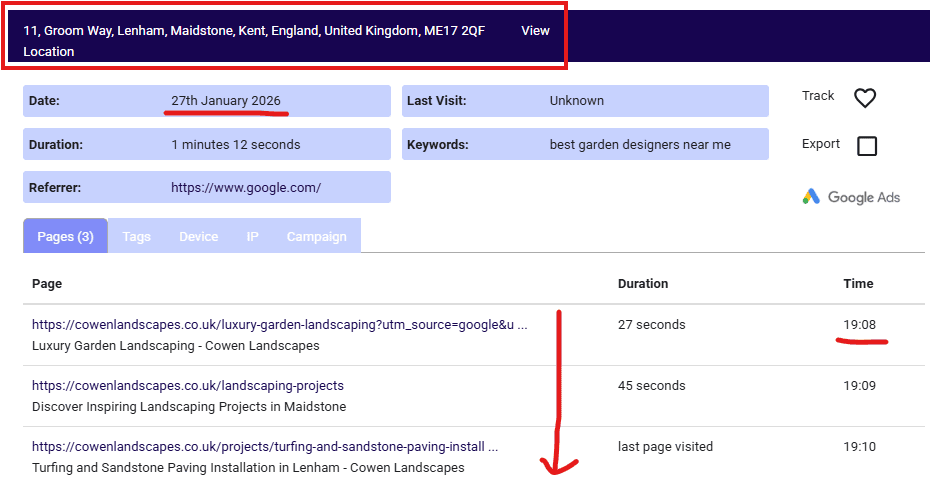
This example shows the home address of a visitor to a garden landscaping business, including the source of the visit (Google Ads) and what the visitor looked at page by page:
How household tracking works in the UK
The process begins when someone visits your website and they see a pop-up that asks website visitors if they are OK about sharing their location. If they agree (10-30% do), then they have given permission for their geolocation to be identified. This is normally a residential address but it can be anywhere else where they are when they visit your website. For example, they could be in a pub, restaurant, or in a car.
The matching process happens in real-time, typically taking just seconds to return results. When a match is found, you see the visitor’s location.
Most visitors can’t be identified this way, but those that can be identified provide useful knowledge that people in those locations are interested in the services or products of the website they’ve visited (or their competitors).
Accuracy of household identification
Household identification accuracy varies depending on several factors. In our experience working with UK businesses, you can expect to identify home addresses for approximately 10-30% of your website visitors.
The accuracy rate depends on:
- Device type: Mobile phones and tablets provide the highest level of accuracy. Although desktop/laptop devices can often be very accurate, that often depends on the internet provider. We recommend focusing mainly on visitors who used mobile devices
- Internet provider: Some ISPs maintain more detailed address records than others
- Property type: Flats and shared accommodation are harder to identify accurately than individual houses
When addresses are identified, the accuracy is generally high – around 85-90% for the correct address, although the visitors location within the property can sometimes make them appear to be in the house next door, if close (e.g. they’re in the garden or in a room adjoining the next house).
Best use cases for identifying home visitors
Household identification works best for specific types of UK businesses and marketing scenarios. Most would send brochures/printed materials to those identified home addresses, knowing that one or more people there are looking for their type of service or product (and would likely have looked at competitors’ websites as well). The printed communication gives householders something tangible to review and share with other decision makers.
Typical use cases are:
Local service businesses: handymen, gardeners, chiropractors, decorators, will writers, and many other types of businesses that provide in-home services.
Higher-value B2C sales: estate agents, kitchen fitters, solar installers, wedding venues, financial advisors, motor dealerships, and other higher-ticket value providers who want to know the addresses of people actively looking for their type of offering.
Leaflet mailers: blanket leaflet-dropping achieves more results when the leaflets contain QR codes that can then identify the addresses of those who scanned them, leading to a follow up mailing of a higher-quality printed communication (e.g. a brochure) to those households that showed interest from the leaflet.
Expected response rates and realistic outcomes
Printed materials landing on the doormat of households are not a guaranteed success, but there will be people in the home who went to the website and so the coincidence of printed materials arriving is very timely and likely to keep their attention, particularly if there is a special offer.
Here are some sample numbers …
Identification rates: 10-30% of total website visitors will be matched to geolocated home addresses.
Response rates: It’s not unusual to get upwards of a 20% response rate, purely because people in the home have been actively searching for what’s on offer.
Costs: If paying for postage, £2-3 per mailing would be normal, multiplied up by the number of homes receiving printed materials. At a conservative 20% response rate, mailing to 50 houses would cost £100-150 and get 10 enquiries from people who could have gone to competitors (who didn’t send them anything because they didn’t have the ability to track their home addresses).
Suppliers of B2C home addresses identification tools
There are many US-focused suppliers of services that identify the home addresses of website visitors. However, they work within US regulations and are not compatible with GDPR regulations in the UK and Europe. In short, in the US marketplace, personal data is freely available, which is the complete opposite to the position within Europe.
Within the UK, there is only Who Visits My Website who supply software that can identify the home addresses of website visitors, plus what those visitors did page by page during their site visit, and also what brought them to the website (e.g. Google, social media, paid ads).
Cost of Who Visits My Website (after a free 30 day trial) ranges from £60-80 per month, with no contract.
It is not possible nor legal to identify the name of people from the identified home addresses and only those who opt in to be location-tracked can have their location identified.
Privacy
Is it legal to identify website visitors in the UK?
Yes – identifying website visitors can be legal in the UK, provided it is done in a transparent and compliant way.
If someone has already given you their details through a contact form, account registration, purchase, or similar interaction, you may be able to track their behaviour on your website as a known visitor. This typically relies on an appropriate lawful basis under UK GDPR, such as consent or legitimate interests, depending on how the data is used.
Some tools also attempt to identify which companies are visiting a website by matching IP address information to company databases. In these cases, the organisation behind the network may sometimes be identified, but not the individual employee who visited the site.
Whether consent is required depends on the technology being used. Under the Privacy and Electronic Communications Regulations (PECR), non-essential cookies or similar tracking technologies usually require user consent. Even where legitimate interests may apply under UK GDPR, PECR rules can still require consent before tracking technologies are used.
Important to know: these systems do not identify the names of anonymous individuals browsing your website. Personal identities are only known when a visitor has voluntarily provided their details.
Household-level identification (for the B2C market interested in home addresses of website visitors) can only be done through consent of the website visitor actively opting in to be geolocated at their location. Only the address is known (no personal name) and so you can only address communications to The Householder or The Homeowner.
Whether B2B (companies identification) or B2C (home address identification), no individual person is being identified – just a location/company.
Can you legally contact people who have been to your website?
If someone has already given you their personal details (for example through an enquiry form, account creation, or previous purchase), you can usually contact them for relevant business purposes, provided they have not opted out of communications.
When visitor identification tools reveal companies or household addresses, you typically do not know the name of the individual visitor. Because of this, communications are normally addressed in a generic way.
For example:
- Direct mail to homes may be addressed to “The Householder” or “The Homeowner”.
- If a company visit is identified, you may research relevant people at that organisation (for example on LinkedIn) and reach out to someone whose role appears relevant.
In the B2B space, you may contact someone who was not the person who originally visited the website. While this can happen in business development outreach, it does not necessarily mean any rules have been broken. It simply means the enquiry may have come from another person within the organisation.
As with any marketing activity, you should always ensure that your approach remains reasonable, transparent, and compliant with UK data protection and marketing regulations.
Technical Setup Requirements
Getting Started with Website Visitor Tracking
Setting up visitor tracking for your UK business doesn’t require a computer science degree, but it does need careful planning and attention to detail.
Choose Your Tracking Level First
Before installing any tracking code, decide which level of visitor identification matches your business needs:
- Known visitor tracking requires CRM integration and email marketing platform connections
- Company identification needs B2B tracking scripts and IP matching services
- Household identification needs B2C tracking code
Essential Technical Components
Every visitor tracking setup requires these core elements:
- Tracking pixels or JavaScript code embedded on every page of your website
- Cookie consent management that complies with UK GDPR requirements
- Data storage systems that handle visitor information securely
- Integration APIs connecting your website to identification services
Working with Web Developers
Although it’s normally a simple two-minute task to install tracking code that identifies companies or houses visiting websites, tracking individual visitors who have chosen to be identifiable by you (e.g. via completing a website form), can often benefit from engaging a web developer who understands local data protection requirements. They should be familiar with:
- GDPR compliance for visitor tracking
- Cookie consent implementation
- Secure data handling practices
- Integration with UK-based identification services
Data Management Considerations
UK businesses must handle visitor data responsibly from day one. Set up proper data management processes including:
- Automated data deletion after your stated retention period
- Visitor data export capabilities for subject access requests
- Secure backup systems protecting against data loss
- Access controls limiting who can view visitor information
Start small with one tracking method, test thoroughly, then expand your capabilities as you gain confidence and see results.
Frequently Asked Questions
Can you see the exact person who visited your website?
In most situations, no. Standard analytics tools such as Google Analytics show how visitors behave on your website but do not reveal their identity.
Some specialist tools can identify the company network visiting a website, or in certain cases the household address, but they typically do not reveal the name of the individual visitor.
This means businesses usually know where a visit came from, rather than exactly who the person was.
The only way you can see the exact person is if they’ve already identified themselves to you through methods including:
- Filling in a contact form
- Creating an account or logging in
- Making a purchase
- Clicking through from an email you sent them
Even the most advanced visitor identification tools cannot tell you that “John Smith from Manchester” visited your website unless John has previously given you his details. This limitation exists for good reason – it protects people’s privacy and complies with UK data protection laws.
How do businesses follow up when they don’t know the visitor’s name?
When visitor identification tools reveal a company or property address, businesses usually follow up in indirect ways.
For example:
- Sending printed information addressed to “The Householder” or “The Homeowner”
- Researching relevant contacts within a company (for example via LinkedIn)
- Reaching out to someone whose role appears relevant to the product or service
Because the original visitor is not identified by name, the follow-up is normally general rather than personal.
Is identifying companies that visit your website common in B2B marketing?
Yes. Many B2B marketing teams use tools that analyse IP data to identify which organisations have visited their website.
This can help businesses understand:
- Which companies are researching their services
- Which industries are showing interest
- Whether marketing campaigns are attracting the right types of organisations
However, these tools normally identify the company network, not the specific employee who visited.
Why do most website visitors never contact a business?
Research consistently shows that the majority of website visitors leave without making contact, even when they are genuinely interested.
Common reasons include:
- They are still researching options
- They plan to return later
- They are comparing several companies
- They prefer to think before contacting a business
- They didn’t like the website
Visitor identification tools aim to help businesses understand who may be researching their services, even if those visitors haven’t yet made an enquiry.
Are visitor identification tools accurate?
Accuracy varies depending on the method used.
Company identification tools rely on IP address databases, which can usually identify the organisation behind a network connection but may sometimes return broad results (for example identifying a large company rather than a specific office).
Household-level identification typically relies on geolocation consent, which can allow tools to associate a visit with a specific property address.
Like all data systems, the results should be treated as indicators rather than perfect certainty.
Do website visitors know they are being tracked?
Yes. UK websites are expected to be transparent about tracking technologies.
Most websites use cookie banners or consent tools to explain what tracking technologies are being used. Visitors can usually accept, reject, or customise their preferences depending on the system being used.
Businesses should ensure their tracking and identification tools are used in a transparent and compliant way.