

How to boost your B2C lead generation and increase conversion rates from your website visitors
Small UK businesses targeting customers at their home addresses need a different approach to lead generation.
This guide shows you practical B2C lead generation strategies that work to attract the attention of homeowners directly from the comfort of their own houses.
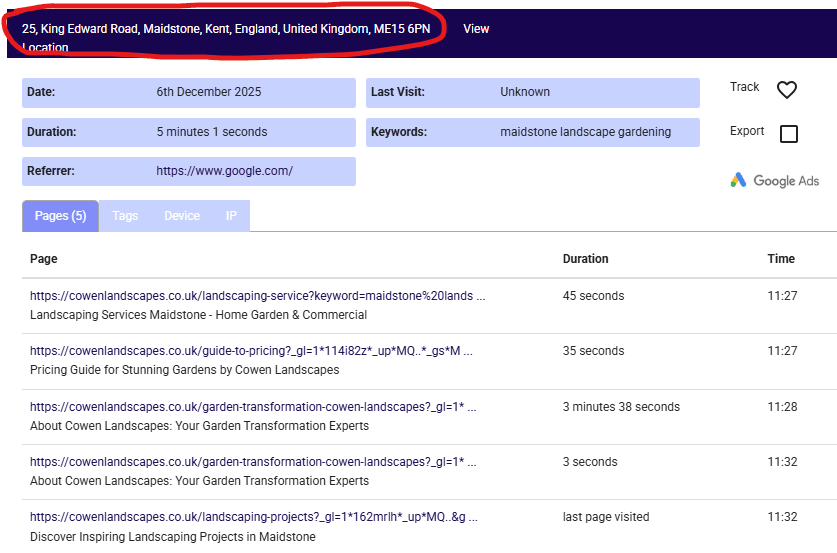
It ranges from strategies to apply when you don’t know who the people were, through to how to approach prospects when you know exactly where they live, as in the example below that shows the precise home address of someone who visited that landscape gardening business website.
Whether you’re optimising SEO, social media marketing, or refining your overall lead generation tactics, you’ll find actionable advice designed for small UK B2C businesses. Most strategies are free or low-cost.
No marketing team? No problem. All tips can be implemented in bite-sized chunks of just a few minutes daily. Start with one strategy, spend 30 minutes a day refining it, then add others using calendar reminders.
What is B2C lead generation?
B2C lead generation is the process of identifying and attracting individual prospective customers who are interested in the products or services of companies that sell directly to consumers.
Those services may be directly related to people’s home environment (e.g. home improvements or financial services) or may be for potential clients that need services outside the home (e.g. a wedding venue or an osteopath).
As a small B2C company targeting people in their homes, it involves you creating marketing strategies that reach potential customers in the eeaiest way, encouraging them to engage with your business so that they initially become leads … and those leads turn into customers.
Unlike B2B (Business to Business) lead generation, where decisions are often more complex and can involve multiple stakeholders, B2C lead generation focuses on connecting with individual consumers, where the decision-making will often be limited to one or two people within the home.
B2C lead generation strategies can include digital marketing, social media, SEO, paid advertising, human engagement, and even direct mail through the post, depending on your audience.
This article supplies you with many different strategies and at least three-quarters of them are free or low-cost.
Why lead generation is essential for small businesses
Lead generation for small businesses is crucial because it provides a consistent stream of potential customers and avoids the feast or famine cycles that so many B2C small businesses know too well.
Consistency is key here – many small businesses have used lead generation tools or companies to create a lead generation campaign, but then it stops. There may have been some success from that whole lead generation process but what typically happens is that you get busy for awhile and then it slows down again.
If you don’t have a solid B2C lead generation ideas strategy that uses a range of different methods, then you risk falling behind your competition and missing out on sales opportunities that those competitors are gaining by building visibility and relationships with people who are actively searching for what you also offer.
The good news though is this: even with a limited budget, your small businesses can increase your visibility … and that includes many no-cost methods you can use.
How to get the most value from this page
I’ve created a video to make your life super-easy when ready to apply the tips on this page to your own business.
It doesn’t matter what type of business you are – all you have to do is follow this guidance …
In the video below I refer to using a prompt, alongside (free) ChatGPT to create you a bite-sized step by step guide to how to implement each strategy that you want to focus on.
All you need to do is to copy and paste the prompt below into chatGPT, as detailed in the video, swapping out the red-highlighted parts for those that apply to your own business:
I am a [insert your business type here] that is looking to grow my business within my local area of the UK, which is [town, town, town, etc.]. The services I provide to people are [service name 1, service name 2, service name 3 etc.]. I have limited time (30 minutes a day) to grow my business and so would like you to create me a list of tasks that I can do within 30 minutes each weekday, that are focused on my type of business, and that are activities ONLY related to the content of the following text – please do not focus on any strategies that aren’t covered in the text: [copy/paste tip text here].
Key B2C Lead Generation Strategies for Small Businesses
Just click on the links below to jump to those parts of this guide or scroll down to read them one by one.
You can also refer to the video above if you’d like to apply these strategies to your specific business type and geographical area you work within.
Identify the house addresses of your website visitors
Optimise your free Google Business Profile
Service-specific case studies within your website
Client testimonials and reviews
Run locally-targeted paid social media advertising on Facebook or Instagram
Find the quick and free SEO wins for your industry
Run locally-targeted pay-per-click (PPC) advertising campaigns with Google and Bing
Complementary business sector partnerships
Brand awareness via local YouTube advertising
Engaging with locally-focused online forums
Referrals from clients to new prospects
Explore retargeting strategies
Getting involved in your community
Identify the house addresses of your website visitors
Most of the people who visit your website won’t immediately make contact for, one of a few reasons:
- They’re still researching options (and will also be looking at your competitors’ websites).
- Your website didn’t give them something they were looking for.
Some of those people (ranging from 10-30%) can be identified by the exact address of where they live (or were at, the time they went to your website).
Just like this:
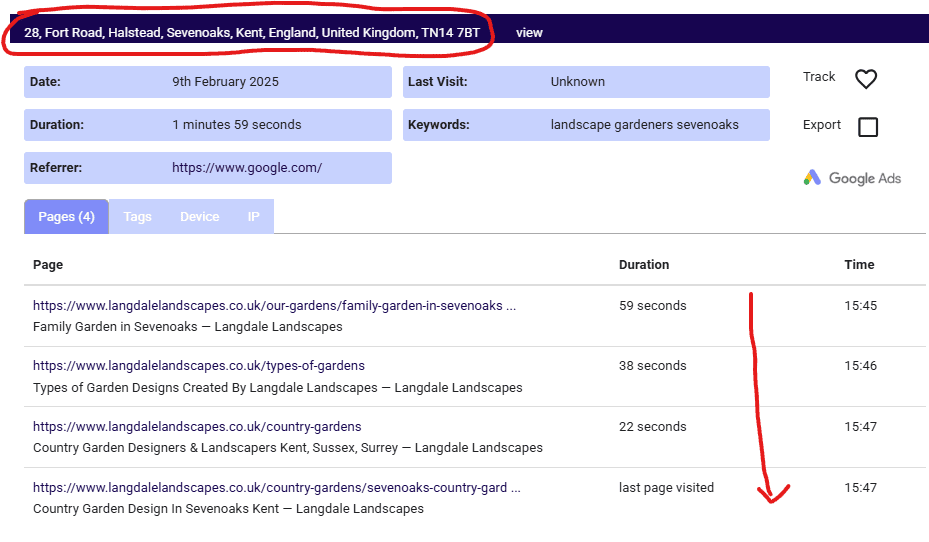
Those identifiable people at their addresses are actively looking for a provider of what you offer, but haven’t made contact with you.
You could send a brochure/mailing to each house identified, so that a day or two after they visited your website, they ‘coincidentally’ receive a brochure that they can browse and share with others who may be part of the purchase decision.
Here’s the good news: your competitors won’t know which houses went to their websites, which gives you the opportunity to stand out by posting something to them.
Exactly what you send to those houses will depend on you, from the basics of leaflets that are created in the right way, through to more effective printed communication delivered to those houses that visited to your website.
You can try this lead generation system totally for free, to prove it works for you – find out more about identifying the home addresses of your website visitors.
Optimise your free Google Business Profile
Your free Google Business Profile is an important part of your strategy to enhance your business’s local search visibility.
Your starting point is for you to type Google searches related to your area.
For example, someone may search for: roofing companies Norwich.
You will see competitors appear in the Google Business listings and your eyes will likely be drawn to those that have the most 5-star reviews.
You may not have a Google Business profile, or you do have one but you are significantly behind your competitors, who have many Google reviews, or profiles completed in ways that benefit them.
Alternatively, you may look at those competitors that are visible and think that they could be relatively easy to beat (depending on the competition in your area).
Whatever you decide, you need to look in detail at the Google business profiles of your competitors and find areas where you can match or exceed them.
It may be that you haven’t completed how many years you’ve been in business, or you haven’t included your hours of availability or included any imagery related to your business.
There are many elements of a Google Business profile that can be strengthened, and a ton of resources online that will help you to identify what they are. To add to those resources, I’ve also created you a much more detailed step by step guide to optimise your Google Business Profile, that will help you focus on one area at a time.
By benchmarking the successful Google Business profiles against yours you can create an action plan for you to consistently work on, always aiming to get into those top three positions that will generate more leads clicking through to your website.
This is one of the easiest lead generation wins for small B2C businesses and requires no financial investment at all.
Website traffic assessment to gain valuable insights into why you’re not getting more leads
If your website has poor levels of website visitors then you can’t expect to increase enquiries for your business.
Through tools like Google Analytics (which is free), you can gain valuable insights into how many people visit your website, and which of those get to the pages related to your services.
A general guidance is that if your website is receiving less than 200 visitors per month then you need to be doing more to bring visitors to your website (and some of those strategies are covered within this page).
It’s not all about the overall website visitor numbers though – you need to be using analytics to identify data including:
- How many of your visitors are from the location (e.g. UK) or region (e.g. Somerset) that you target (because they’re the only market you’re selling your services to and so the only visitor numbers of value to you)?
- How many people are getting to specific pages of your website? If you don’t have separate pages for each type of service or product then you should have!
- Are people getting to content pages (e.g. blogs you write), but not getting to your core service pages? For example, you may have written a blog but you haven’t created a call to action that takes people to that specific service page.
One of the most valuable website traffic elements to consider is the relationship between service or product page views and how many leads you get.
For example, if you have 100 people who, in total, got to individual service/product website pages, but you had only one enquiry from the 100, then it indicates that your pages aren’t strong enough to give people enough reason to make contact with you. Such insights may appear to be depressing, but they’re valuable to be aware of because they’re what encourage you to implement website changes that will increase your website visitors conversions to enquiries.
Interpreting website visitors analytics can initially feel like a bit of a chore but some people in small businesses surprise themselves when they start looking at Google Analytics, evolving from fearing it to enjoying the lightbulb moments when they see useful information within the data about their website visitors.
To help with this, we’ve created a separate guide to how to use Google Analytics to get insights into website visitors behaviour. However, if you still feel that Google Analytics is something that you’re not comfortable getting into, it’s very much worth installing it on your website and bringing in expert advice to help you understand what your data is saying about whether you’re visible to the people in your target area, and whether those people have found enough to make them want to make contact with you.
Focus on scenario-specific case studies within your website
Two key thoughts are going through the heads of people going to your website:
- Can you help me with the service you offer?
- Can you prove that you’ve successfully done it for other people?
Your website needs to have individual pages dedicated to each type of service that you offer. Think about what you offer overall and then break that down into sub-levels within your industry. For example, if you were a financial advisor you would have individual pages to cover these:
- Pensions
- Investments
- Tax planning
- Wealth management
- Estate planning
- Inheritance tax planning
- Financial protection
If your website doesn’t have a dedicated page for each type of service you offer then you are losing out on getting more leads to become website conversions, and are also missing out on SEO (Google visibility) opportunities (see further down in this article).
The big problem with most websites though is that they don’t provide plenty of examples of how they have helped clients … prominently within each service type page.
For example, someone is on one of your website service pages that explains how you can help but what they are actually looking for are numerous examples of customers that you have provided that specific service to.
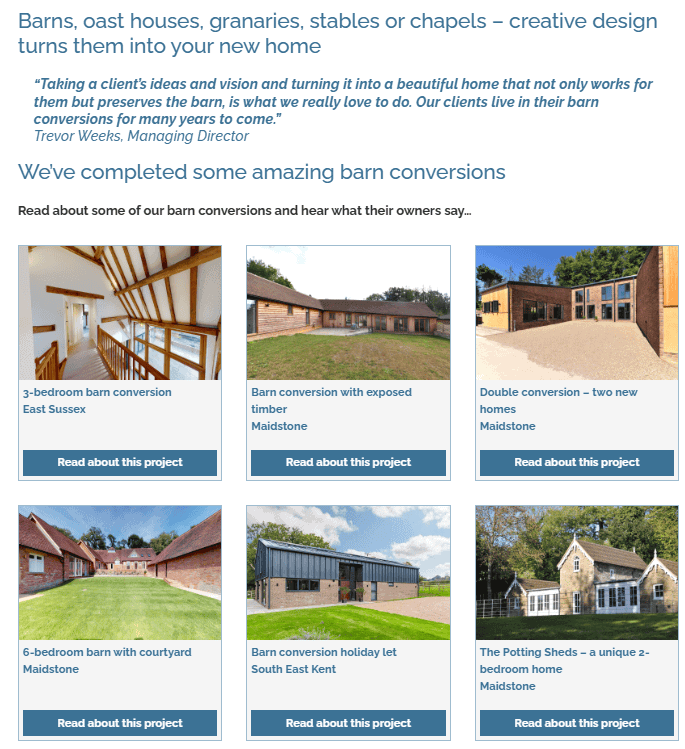
Those examples need to be brief introductions on the service page, allowing people to click through to detailed case studies. Here’s an example from a building services company that has barn conversions as one of their service pages and very early on the page encourages people to click through to examples of their barn conversions work:
For the detailed case studies that people click through to, they would ideally contain information in this order:
- Imagery (this only applies to case studies that would have associated imagery).
- The solution – a summary of how you helped the client with that specific service. For some types of service (e.g. a chiropractor), you can focus on loyal customers who have used your services repeatedly.
- How we got to the solution – explain the original challenge the client had and how you worked with them to achieve a successful outcome.
- Testimonial (where available). Ideally, this would be a customer review that names the client. However, where it’s not possible to name the satisfied customer, they can be anonymised.
How many of these case study summaries should you have on each individual service page?
As many as possible, and keep adding to them.
People aren’t interested in one, two, or three people you’ve helped with that specific service.
They’re interested in having the option to browse through numerous examples of where you’ve provided an amazing service to customers.
If you don’t believe this advice, then try it out on just one of your service pages. Then, provided you have traffic to that page of your website, you’ll see evidence in the form of a higher percentage of enquiries about that specific type of service (than any others within your website).
The overall rule is: people will only care about how you can help them AFTER you have proven that you have helped others with exactly the same type of service that they are interested in.
So how do you get these case studies?
Ideally (if you have a contract) you would include an incentive for the client to commit to providing a case study (or, more likely, for you to write one and they then approve it) when they are 100% happy with the service you’ve provided for them.
Soon after you have completed your work for the client, or at a stage where the client is particularly happy with the outcome, you send them the case study that you have crafted, along with a request similar to:
All that’s missing are a few words about how you feel about my work with you – would it be ok for you to send me back a few words that would also inspire other people to use me in the future?
Most people will be only too pleased to add a few words to your pre-prepared case study. Some of course may wish to be anonymous, and so you could assure those people that you wouldn’t add the name to the case study, just the town they live in (which will also help a bit with your organic SEO).
Client testimonials and reviews
People looking for any types of service don’t want to waste time with someone who doesn’t get them results, which means that you have to very visibly prove how good you are.
There are two main places that people will get such evidence:
- On review platforms
- Within your website.
Review platforms
There are many places where people can leave you a positive review. Examples are:
- Google Reviews
- Trustpilot
- Industry-specific review sites
- Feefo
It’s your job to build those up as much as you can, and certainly to the point where you have more than your competitors within your geographical target area.
Reviews are also a good starting point – look up your competitors and look at the reviews they have on review platforms … and then strive to exceed what they’ve achieved.
Reviews should be easier to get at the time when you have succeeded in achieving and exceeding the expectations of your customer because at that moment they are likely to be ecstatic, which makes it the perfect time for you to ask them if they will provide you with a positive review.
Ideally, you would have a standard email ready to send them, showing them how to leave you a review on each of the websites that you can be reviewed on. You can even give them an incentive to encourage them to post their review on multiple review sites at the same time (rather than just one).
Your objective is to get a positive review from the majority of clients that you have successfully helped, always working towards exceeding what your competitors have achieved on each review platform.
Those reviews will also make it easier for you to increase sales from your leads because there will already have been some trust built up. You’ll be familiar with this if you’ve ever looked at the reviews of a potential supplier prior to contacting them.
Within your website
When you have reviews in other places (e.g. Google reviews, Trustpilot) then you can use plugins to make those reviews also automatically appear within your website.
What you need to do though is make sure those reviews are visible in many different places within your website so that whatever page someone is looking at, they will be drip-fed the messaging that you get great results for people.
Try to avoid the common mistake of your reviews only being visible on a page of your website that people may never go to!
Run locally-targeted paid social media advertising on Facebook or Instagram
Most UK small B2C businesses work within a local area. This makes locally-targeted paid social media marketing advertising campaigns via channels such as Facebook and Instagram an easy win IF you’ve already ensured (see the points above) that your website has enough strength to convert clicks to enquiries.
Localised social media advertising works within a budget that you set and not only increases your reach but also allows you to precisely target demographics, interests, and behaviours.
What’s key here is not to have adverts that blandly tell people what you can offer them, but instead to find an angle that will interest people enough to click through to a website that then backs up what your advertising says.
For example, a Facebook ad to your local audience could mention the number of clients you’ve had, plus your Google reviews rating over the past 5 years. It could also refer to a specific service you provide and take people through to that website page that includes numerous examples of how you have exceeded expectations.
As with all paid advertising though, it’s important to measure the results from your paid social media advertising – especially if you do it yourself rather than via an expert. If you find that your rate of clicks and spending on ads is not resulting in enquiries from those clicks then there are only two reasons:
- The advertising has not been set up in the right way. It could, for example, be attracting the wrong audience.
- Your website is not strong enough to increase enquiries from those clicks.
Using local print advertising to get more leads
Leveraging print advertising can significantly raise the visibility of your service and generate a pool of potential leads.
However, you do need to be selective about which publications to advertise in so that you’re mostly visible to your ideal customer – it may appear to be the easiest answer putting an ad in the local mag, but it’s best to do some research first.
Start by consulting with friends, family, and contacts in the local area, seeing which local newspapers, magazines, or other printed material they receive, and what their views are on each.
Some may be targeting everyone, whereas others may be targeting a specific demographic (e.g. people of a certain age range).
If you identify print publications that look promising – and you may not! – then contact some of those businesses advertising in those publications, to get a view of how well (or not) it works for them.
If you decide to engage with one of those print publications, and their advertising terms and costs are acceptable to you, you will need to design the content of your advertisements in a way that would appeal to your ideal customer. You may have the skills to create the design via something like the free version of Canva or may prefer to outsource it to those who are skilled in design. Either way, the cost of the design itself is likely to be very low.
Find the quick and free SEO wins within your industry
SEO (search engine optimisation) is under-utilised by most B2C companies, and there are some very easy quick wins before considering deeper SEO strategies.
This is not intended to be a detailed focus on how you can improve your search engine rankings, as the topic of SEO goes into a lot more detail than can be covered on this page, although I have created a very detailed page of free SEO tips for small local businesses in the UK here.
The focus below is more of a starting point to identify some quick SEO wins for your B2C business.
Your overall objective is to be high in search engine results (free) when people are typing in phrases related to the services you provide.
Here’s a test you can do:
- Go to Google.
- Type in one of your service types, plus your location (e.g. builders Canterbury).
- See which companies appear, and where your website is in comparison.
If you’re not happy with your Google positioning then here are two activities for you (the second activity applies across multiple pages) …
Address in the footer
Add your full business address into the footer of your website, so that it appears on every page. This makes it clear to search engines and humans where you operate from.
For example:

Meta title and description on each page
Within the back end of your website, you will have options to change the meta title and description.
Google displays your meta title and description (although not always the description) in the search results when people search for keywords that are related.
These are where you need to include (but not overdo) your geographic and service-specific references.
Here’s an example of an osteopath who has edited both their meta title and description for their back pain page. The bold-highlighted words are just there to show you how those keywords would appear within a Google search for ‘back pain help Maidstone’:
Meta title
Back Pain Relief Maidstone | Scott Jones Osteopath
Meta description
We have helped relieve back pain for over 1200 customers in Maidstone and the surrounding area. See our many case studies & testimonials.
Do that for each service page on your website, plus also ensure that all other pages of your website have unique metadata, and the search engines will look at your website more positively. Not overnight, but certainly within six weeks as they pick up on the changes made.
As noted already, these are just the very basics of local search engine optimisation and you can achieve a lot more with further advice, but these are good starting points that can help you gain the quick wins that are enough to get you higher in the search engine results. To truly benefit though, I recommend dedicating time to reading and implementing all the tips I provide here.
Run locally-targeted pay-per-click (PPC) advertising campaigns with Google and Bing
So: you want to be visible when people are typing related searches into Google or Bing, and those people are within your geographical target area. For example:
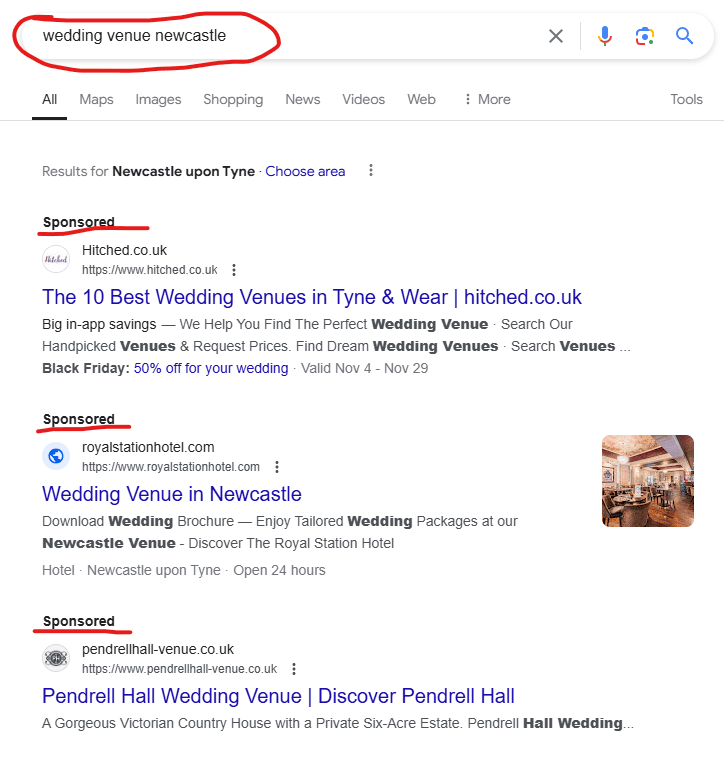
Here you have to tread a bit carefully because although it’s very easy to get high visibility in the paid ads of Google and Bing, it’s also very easy to make mistakes if you’re unfamiliar with how each pay-per-click system works.
There are so many people who say that PPC advertising doesn’t work, but the reality is:
- Their websites weren’t strong enough to convert clicks to solid leads.
- Their PPC setup was flawed and brought in the wrong types of website visitors at too high a cost.
It can’t be overstated enough: the paid advertising systems will empty your budget if you don’t know how to work them properly.
Using PPC advertising on Google or Bing will have a cost to it and so the guidance here is to determine the value of an enquiry for you and how much you are prepared to pay per customer acquisition.
For example, if each PPC click costs you £4 and one in five clicks gets a lead for you, then that’s a £20 cost per acquisition.
This article doesn’t have space to go into the depths of how to ensure success from your PPC advertising, so please do ask if you’d like more insights.
The basics of using PPC advertising (e.g. Google Ads or Bing Ads) though are this:
- Set the targeting of your account to be only within specific postcode areas (or a radius out from where you can supply your services).
- Create campaigns and ads that are very specific (e.g. one for one type of service, one for another type of service, etc.).
- Use very precise keywords (e.g. [chiropractors Portsmouth]).
If you are at all unsure about this (and you should be as your expertise is in what you provide, otherwise you’d probably be making more money being a PPC consultant!), then take advice, including reaching out (we’ve been helping clients avoid wasting budget on Google and Bing for many years).
Content marketing
Although your target market may be very localised, there are website SEO (Search Engine Optimisation) advantages from you creating great content that could be linked to from other websites. Examples of great content you could be creating are:
- Create informative blog posts and articles relevant to your industry focus.
- Offer free downloadable guides or e-books that people would find useful.
It could also be the case that you can provide your services to anyone in the UK – particularly if you seem to be the only viable option people have.
Going into more detail on this, say you offer mortgage services and you create a blog post titled, and all about ‘how to get a mortgage for a self-employed construction worker’.
You may have the words to create an article (aim for an article of 1,000 – 1,500 words) or you may choose to utilise AI to create the basis of an article that you could then refine. Here, for example, are the first two paragraphs from an article on the topic we’ve chosen as an example:
How to Get a Mortgage for a Self-Employed Construction Worker in the UK
Introduction
Securing a mortgage as a self-employed construction worker in the UK can be a challenge, but it’s far from impossible.
Unlike traditional salaried employees, self-employed individuals face a unique set of hurdles when it comes to obtaining a mortgage. In this article, we will explore the specific steps and considerations for getting a mortgage as a self-employed construction worker in the UK.
The Self-Employed Challenge
One of the main challenges for self-employed construction workers seeking a mortgage is proving their income and financial stability. Lenders typically rely on payslips and employment contracts to assess a borrower’s financial health. When you’re self-employed, these traditional documents may not be readily available.
After creating such an article you wait a few weeks to see if Google pick up on it (you’ll know because your website visitors analytics will start showing you people are landing on that page).
After your article has been picked up by Google (and, hopefully, you’re seeing yourself get to the first page of results either without more effort or with a bit more SEO focus within your website), you can then reap these benefits:
- People will link to the article. In the example of the article focused on the topic of ‘how to get a mortgage for self-employed construction worker’, people within construction-related websites may link to it if they’ve found it useful enough to share with others who could benefit from it.
- You can then introduce calls to action within the article. For example, two or three times within the article you could have a graphic call to action encouraging people to click through to another page of your website to get help. The messaging will vary but in this case, it could be: See examples of self-employed construction workers who we have helped to get mortgages (which takes people off to a page that gives examples, plus your contact details, while making it clear that you help construction workers all over the UK because your business is not geographically-limited).
In summary, all you have to do is create content that relates to what people may be searching Google for, is typically quite a niche topic, and has the opportunity to gain you website backlinks and also generate leads.
Here’s the good news: most UK B2C-focused small businesses produce generic, short, and non-targeted content, so the bar for success is very low, making this one of the easiest lead generation ideas you could focus on.
Complementary business sector partnerships
It’s likely that you have already done some of this, but by collaborating with UK businesses that share a similar clientele, you create a network that not only benefits from referrals but also builds a strong, trustworthy reputation.
Taking an example of a will writer, typical complementary small businesses would be:
- Hairdressers (who are great at finding out about people’s lives!)
- Mortgage advisors
- Insurance brokers
- Solicitors (who don’t focus on wills)
- Charitable organisations that have an older demographic
A simple example would be when a hairdresser encounters a client who’s talking about someone they know who has died and left a mess, which can lead to a conversation about how a trusted contact of the hairdresser could have helped (and the client becomes interested because they are worried about their own lack of will provision).
Of course, it won’t always be a two-way relationship of passing leads but most service providers would be happy to remunerate people who have increased leads for them.
It’s also worth considering that many of those you would like to build relationships with could already have ties to others within their normal networking activities.
An example of this would be BNI, which only allows one person from each industry within each group (Chapter) in that geographical area. Those people meet regularly, build up trust, and pass each other business when opportunities arise.
There are of course many other groups similar to BNI and such groups are worth considering (if they don’t already have someone from your industry), as they can provide a solid stream of leads.
Brand awareness via local YouTube advertising
Have you ever been on YouTube and seen an advert appear for a business targeting people within your local area, normally when you are about to watch a video and have to wait to skip the advert?
And what about your competitors advertising in that way?
You’ll find that it’s rare to see your competitors advertising via YouTube, which means that it’s a great opportunity for you to stand out.
It’s also not expensive to advertise in that way.
While YouTube ads may not always result in immediate clicks, they will significantly raise your brand’s profile among your target audience and when prospects in your local area repeatedly encounter your ads on YouTube, they become more familiar with your brand.
That type of heightened awareness pays dividends when they eventually require your type of services, or mention you to someone else interested in those services, purely because they remember you from their own YouTube activity.
Just because other local small businesses aren’t advertising on YouTube in this way, doesn’t mean you shouldn’t. It just means that the others haven’t been thinking big enough.
It’s not expensive to get that brand awareness on YouTube (you set it up within the Google Ads system), and the costs of video production are likely to be less than you think they’ll be. You also have the option of using free or low-cost AI-assisted tools to create videos, which are becoming increasingly better at what they can do.
Engaging with locally-focused online forums
Engaging with local online forums is a slower burn strategic move to establish your presence and expertise within your target geographic area.
Two examples of local online forums are Nextdoor and the many Facebook groups that cater for local areas.
Obviously, if you join those forums and start pitching your services then you’re going to alienate people and fail to generate leads for your business.
It’s far better to join the forums and participate in discussions both generally and where you can provide added value.
Your goal is to become a trusted and helpful figure in the community so that when any online discussions turn to areas related to your business focus, then people will take notice of someone who is an expert in that area, having already proven yourself as being generally helpful on the forums.
It takes time to build up such trust but the knock-on effects will benefit you both within the forums and also in the real world where you may find yourself in a conversation with someone who is aware of you from the online forums.
Referral-focused networking
Join local UK small business networking groups to build relationships with two types of people that can help with getting B2C leads for your business:
- Close to your sector: people in complementary business sectors who are likely to know of people who may be looking for your types of services.
- Everyone else: other people in your networking group may entrust you with their own contacts who are looking for your types of services.
BNI is an example of a business referral group where they will have only one of each business focus in each area, and the mutual trust within the group makes it easy to give and receive referrals to and from the range of different business types represented in each group.
However, it may be that your sector ‘seat’ has been taken in some BNI groups, but new groups do get created and there are also sometimes people who leave groups. So it’s worthwhile being connected to BNI members (whoever they are) so that you can pick up on opportunities to join a group when they arise.
There are of course many other types of networking groups that could be useful to participate in but you are more likely to get new leads from those that focus on referrals rather than more generic networking.
Referrals from clients to new client prospects
By offering referral incentives to your own clients, you can create a win-win situation. Satisfied clients are more likely to refer friends and family when they know there’s a tangible benefit for both parties.
Whether you do that through a formal referral programme that provides financial referral bonuses (e.g. £100 per referral that becomes a customer), or other incentives, you motivate people to actively refer potential leads to you.
Naturally, many of your clients would probably willingly refer their own friends and contacts to you but you can make it even easier with a referral incentive.
And of course, word-of-mouth referrals are typically the best way to generate high-quality leads because they come with a built-in level of trust. After all, there’s that social proof that you are trusted.
A question you may also ask yourself is: how do I stay in contact with my clients?
An option to consider is, when they have benefited from your services, to ask them if they’d be happy to receive a bi-monthly or monthly email newsletter from you. If they agree (which in theory most would, as they’re happy with your service and would want to help you), then you can ongoing repeat the referral incentive within those email updates you send out, ensuring that they are ongoing reminded of who you are and how you helped them (and can help their own contacts).
Explore retargeting strategies
Retargeting, sometimes called remarketing, is a way of ‘following’ people who have been to your website.
You’ll be familiar with this if you’ve ever been to a website and see graphics/adverts appear related to other websites you’ve been to before – that’s retargeting.
How it works is this:
- Someone visits your website.
- They are ‘cookied’ so that they will see your adverts appear when they go to various other websites.
- That visibility of your adverts costs you nothing.
- If they click on the adverts (to go back to your website), the cost of those clicks is very low (typically 10-40p per click would be normal).
- You then get a second chance to impress the potential customer via your website and even if they don’t click on your advert, they will regularly see your brand in front of them so that could make you top of mind when they are ready to consider your type of services in more detail, and so lead to an increase in enquiries.
Retargeting is part of paid advertising systems like Google Ads and Facebook Ads and although you do need to spend a bit of time to set them up correctly, it’s time well-spent to follow people online after they’ve been to your website.
Although systems vary, Google Ads will allow you to ‘follow’ a prospective customer with your adverts for up to 18 months after they have visited your website.
The vast majority of your competitors won’t be using retargeting strategies and are losing out on lots of free brand awareness advertising.
Educational blogging
Hosting a blog/resources section on your own website allows you to create a library of informative and educational articles related to your industry expertise.
These resources not only educate your audience but also serve as valuable SEO (search engine optimisation) content that can improve your website’s visibility in search engine results.
By consistently producing high-quality content, you will be sending out a positive message (to the search engines) that you are a website that’s regularly updated and worth visiting.
The type of blog content you could create is endless. Taking the example of just one topic for a chiropractor (back pain relief tips) you can create multiple blogs that are all different to each other but are focused on those specific areas.
For example:
- Simple 1-minute exercises to avoid back pain when working from home.
- Instant relief tips for when back pain is unbearable.
- Medicines to use (and avoid) to help with back pain relief.
Through consistent educational blogging, you will build the respect of search engines and start to become visible for various keywords in Google searches.
If you can help people outside your local geographical area then you can make it clear on your blog pages that distance is no object (because you can help people remotely).
Or, if you only work within a certain geographical area, the blogs are still useful information for people to have and, in some cases, people will link to them.
There is also the topic of having gated content on your website. You’ll be familiar with this when you’ve been to websites that offer you something potentially useful but you have to provide your email address to get access to it. It’s effectively useful/valuable content that’s behind a ‘gate’, rather than being openly visible on a website.
Opinions differ on whether gated content is a valuable strategy because although it does have the advantage of the website owner getting email addresses and names to add to their email list, many people would prefer to see useful content readily available.
What’s more typical is for companies to provide a lot of valuable content for free but to also have additional gated content that people can sign up for.
Getting involved in your community
Although it can be time-consuming, active involvement in your community can help to strengthen your local presence and reputation.
Volunteering in community events or sponsoring local charities or events can be a powerful way to increase your brand visibility while demonstrating your commitment to the community.
This community-oriented approach and visibility of you as a giver can result in generating leads for your B2C-focused business because people often prefer to engage with people who actively contribute to the well-being of their community.
Video Marketing
Video is a highly impactful method of business growth because it attracts views from people who would prefer video to text.
All you need to start is:
- Your own YouTube page, which is free to set up and keep.
- You create short videos that are educational and useful for anyone who may see them.
Those videos can be embedded within pages of your website (e.g. a plumber could create an article about unblocking a toilet and support it with a video of them discussing the topic).
Or, more commonly, you would record the video and then also get it transcribed as text within your website page article.
A tip to get started with this is after you’ve been talking with a prospect or client – all you have to do is summarise that dialogue while talking to the camera (on your phone will be fine) and you will have immediate video content that can be used within your website/YouTube channel.
The quality doesn’t matter so much – people will always buy more into useful and real-life content than a perfectly polished video.
Not sure if video is something you want to get into?
It can seem daunting at first but the best videos are from real people, rather than flashy production. People care about what you say more than they care about presentation.
Just do some searches on Google and click on the Videos tab to see what appears when you type search phrases related to your industry.
Chances are that there are huge gaps in the market for relevant videos related to the services that you can provide.
Common mistakes to avoid in B2C lead generation
When executing small business lead generation strategies, some common mistakes can waste time and resources:
Mass paid visibility before testing
You want to generate large numbers of leads so you use a paid form of lead generation that makes you visible to higher numbers of people, but that visibility has cost you money.
It could be digital (e.g. Google Ads or Facebook Ads) or offline (e.g. you’ve had hundreds of brochures printed and delivered to houses) and the hope is that it works.
If it fails then you’re not going to be happy.
All paid advertising campaigns should be tested in smaller numbers/costs to prove that they work initially.
THEN you can spend more when you know all the component parts of the visibility have gained you more leads.
Trusting the wrong people
Unfortunately, some people will happily get you to spend on their lead generation services, but they don’t get you results.
It may not be intentional but the outcome is that your time and budget spent didn’t get you the new leads you wanted.
That’s why you need to test (see the previous point), but you should also try to find out more about the people you’re planning to engage with.
Be particularly careful of people who want you to spend a lot, or can’t give you any indications or guarantees of what return on investment you’ll get.
You would do well to have a mantra of “show me how I can spend a little and see a little results and then we can have a bigger conversation about how you can help”.
Targeting the wrong audience
One of the most common mistakes in B2C lead generation is casting too wide a net. Instead of trying to reach everyone, focus on a well-defined target audience. Without proper segmentation, your messaging won’t resonate, leading to low-quality leads and wasted marketing spend.
For example, if you offer a premium rate garden landscaping service and don’t target your Google Ads to specific geographic locations, and with distinct ‘upmarket’ messaging in your ad text, you will end up with clicks and enquiries from people who want their gardens mowed or hedges trimmed.
Over-reliance on one channel
When a lead generation channel appears to work then it’s tempting to focus more of your marketing efforts on the same.
What if, one day, something goes wrong with that channel and your leads dry up overnight?
For example, a paid advertising campaign gets a problem with it, your organic Google positioning drops off, or your website crashes.
Diversifying your lead generation marketing efforts prevents you having too many eggs in one basket which could cause a big problem at any time.
Ignoring the power of follow-up
Many small B2C businesses fail to follow up with leads promptly, missing out on potential conversions.
Timely follow-up emails, messages, or phone calls need to be consistent to move leads through your sales funnel (even if that funnel is very simple). Letting too much time pass can result in leads losing interest or moving on to competitors.
Overcomplicating the lead capture process
Complicated or lengthy forms are a common mistake that discourages potential leads from converting. Keep website forms simple, asking only for essential information at first. You can always gather more details as you nurture the lead further down the funnel.
Underestimating the importance of mobile optimisation
With ever-increasing consumers browsing and shopping via mobile devices, failing to optimise your website and landing pages for mobile users can cost you valuable leads.
You need to fully test (don’t blindly believe what your web developer or marketing person says) aspects of your lead generation, from ads to landing pages and where people click afterwards. You may find problems that can be fixed before you actively spend your budget on being visible to people who are on their mobile devices.
Frequently Asked Questions
What are some free or low-budget small business b2c lead generation ideas?
For small businesses with limited budgets, we’ve covered many of these within this article. To recap on some of those, free or low-budget options to consider are:
- SEO (search engine optimisation) – ensuring that the content of your website, including service-specific case studies and supporting knowledge, are all built into your website so that you have a higher opportunity to be visible in Google.
- Client testimonials/reviews in public review locations (e.g. Google reviews) will raise your credibility and visibility online.
- Analysing your website visitor patterns – from the free Google Analytics and free Microsoft Clarity to fee-based systems, there are software tools available that will help you to better understand your website visitors and make positive changes to your online presence.
- Complementary business sector partnerships – who can you partner with to mutually raise awareness of your businesses?
- Social media visibility (either free or low spend on ads).
- Engaging with very local online communities.
- Optimise your free Google business profile.
How can I test if my lead generation strategies are working?
Testing small is key to improving your small B2C business lead generation efforts.
Reject anyone who wants you to spend a lot on what they say will work. Instead, ask the question: how can we test this out on a small scale to prove to me it works?
The ultimate test is how many enquiries you get from a lead generation strategy. If, for example, you have delivered brochures to 100 houses or have had 100 clicks from an online advertising campaign, then you’ll have a picture of what was achieved. If results are good then scale it up. If they’re not good then you’ll need to drill down into the reasons why.
What are some short-term wins for lead generation?
This depends on budget much of the time because most short-term wins (within a few weeks) will generally come from a form of paid advertising.
If, for example, you had the budget to spend on localised Facebook or Google Ads visibility, and you tested on a small scale, you could gain some short-term wins (or at least quickly know if there was a problem with part of the marketing).
What longer-term strategies should I consider for b2c lead generation?
For longer-term success, you will benefit from a focus on building a strong online presence through content marketing and SEO.
Regularly creating valuable, relevant content will help you attract more organic website traffic over time, but it does require analysis and effort.
Your starting point would ideally be utilising a software tool that compares your website to that of your competitors when people search Google on keywords that relate to your business. That will quickly show you exactly where you stand and can then evolve into the longer-term strategy that will get you to a position where you’re more visible than your competitors.
Finally …
You’d normally expect to see a sales pitch by now within an article like this, but you’re not going to get one.
Hopefully, some of the B2C lead generation tips in this article can be put to use within your small business, but if you do have any questions, please do feel free to get in contact for some free advice.