

What you’ll get from this page
This guide shows small B2C businesses how to use a cover letter alongside a brochure to re-engage high-intent households (that have been to their website) in a natural, non-intrusive way.
It covers the role of the cover letter versus the brochure, how to position the mailing as a helpful resource, and how to include shareable offers that prompt contact or referrals.
A complete example cover letter is included, designed to feel coincidence-based while still encouraging action.
You’ve identified the home addresses of your website visitors – now what?
If you’re using our home addresses identification software then you’ll know the exact house address of people who have been to your website (and what they looked at page by page).
Those people have looked at more than just your website and haven’t yet made a decision to buy. Your prompt actions next will re-engage those people who may not have found quite what they were looking for on your website, but could be encouraged by what you send them in the post.
Brochure? Letter? Both – and perfectly crafted
If you know for a fact that someone in a house has been to your website and is actively looking for the type of services you provide, you should treat them like gold dust as they are the hottest prospects you’re likely to get.
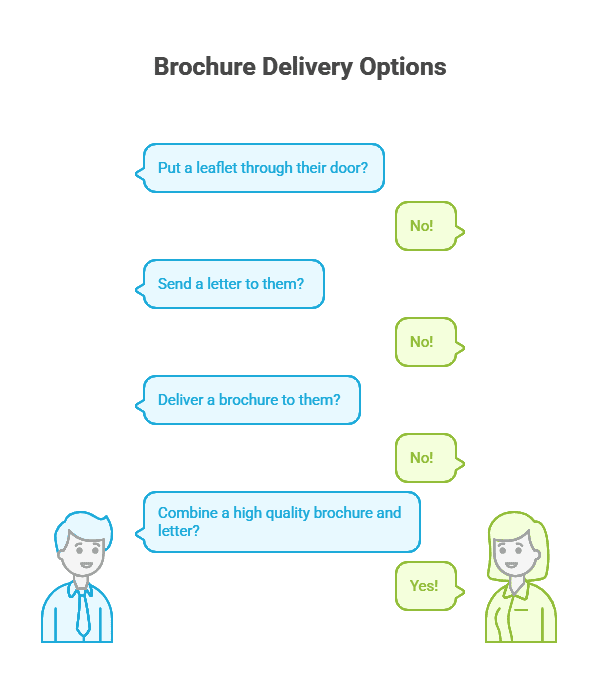
Put a leaflet through their door? No!
Send a letter to them? No!
Deliver a brochure to them? No!
Combine a high quality brochure and letter? Yes!
Many B2C businesses invest time and money into creating a high-quality brochure – professionally designed, well written, and capable of explaining their service clearly. On its own, that brochure does an important job.
But when the brochure is being sent to a specific house address, especially where you know that someone in that property has recently visited your website and likely compared you with competitors, the brochure alone is not enough.
This is where the cover letter becomes the most important part of the entire mailing.
Used correctly, the brochure and cover letter work together:
- The brochure explains what you do and how you do it
- The cover letter explains why this brochure has arrived now and what the reader should do next
Understanding this relationship is the key to re-engaging high-intent households without making them feel uncomfortable or “watched”.
The reality behind the mailing (and why discretion matters)
In this scenario, your business:
- Knows the exact house address of someone who has visited the website
- Knows they are likely researching and comparing alternatives
- Wants to re-engage them before they choose a competitor
However, despite the household having opted in to be identified (they clicked a link when they went to your website), the cover letter must never acknowledge or hint at this directly.
Even if the timing feels coincidental to the recipient, your goal is for it to remain a coincidence in their mind.
That means:
- No references to website visits
- No references to online interest
- No implication that behaviour triggered the mailing
Instead, the communication must look and feel like a local, useful, pass-along resource.
Why your brochure stays generic – and the letter does the work
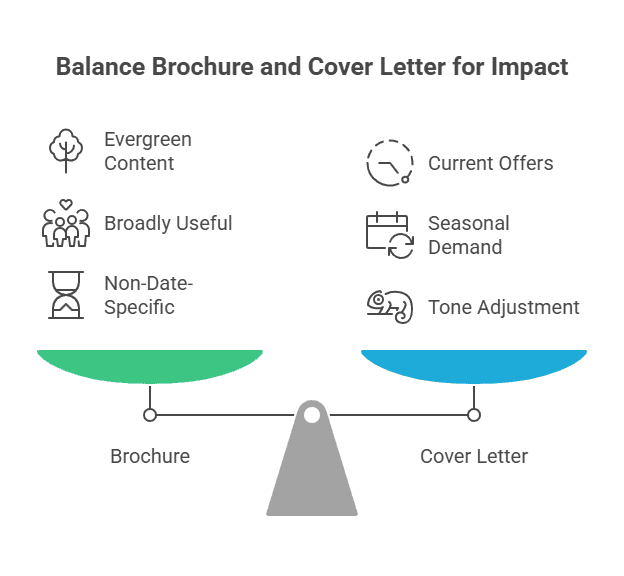
A brochure should be:
- Evergreen
- Non-date-specific
- Broadly useful
- Suitable for anyone at any stage of consideration
This makes it ideal as a long-term asset, but weak as a prompt to act.
The cover letter solves this.
Because the letter:
- Can change regularly
- Can reference current offers
- Can reflect seasonal demand
- Can adjust tone, urgency, and messaging
…it becomes the activation layer that sits on top of the brochure.
In short:
- The brochure builds confidence
- The cover letter creates momentum
The safest and most effective positioning
Although the mailing is delivered to a specific address, the purpose of the letter should be framed as usefulness, not targeting.
The strongest angle effectively says this to the recipient:
“This is something you may find useful – or something you might want to pass on to someone you know.”
This achieves several things at once:
- Reduces any feeling of being singled out
- Makes the letter socially acceptable to read and keep
- Encourages sharing with friends, family, neighbours, or colleagues
- Still works perfectly if the recipient themselves is the buyer
The role of offers – why they belong in the letter, not the brochure
Offers are time-sensitive by nature. That makes them a poor fit for brochures and a perfect fit for cover letters.
The letter allows you to:
- Introduce a current incentive
- Test different offers over time
- Track response using a simple quote phrase
- Create a reason to enquire now rather than “later”
Crucially, the offer should be:
- Area-based, not person-based
- Shareable
- Low-pressure
- Framed as a thank-you, not a discount grab
This keeps the tone premium and trustworthy.
Example: a pass-it-on focused cover letter
Below is a sample and adaptable cover letter designed specifically for this scenario.
It assumes:
- You know the address
- You do not know the person’s name
- You want the mailing to feel helpful, not targeted
- You want to encourage both enquiries and referrals
To the Householder,
We’re currently sharing this brochure with a small number of homes in your area as a useful reference for anyone who may be looking into [insert your service here] now or in the coming months.
Even if this isn’t something you personally need, people often keep information like this to pass on to a family member, neighbour, or friend when the topic comes up – so please feel free to share it with anyone you think might find it helpful.
The brochure gives a clear overview of what we do, the types of projects we help with, and examples of work we’ve completed locally. Many people tell us it’s useful to have something straightforward to look through when comparing options or making a recommendation.
As a small thank-you, if anyone who contacts us and quotes [insert a unique reference – e.g. SPECIAL10] mentions this brochure, we’ll include [insert here your special offer – could be a unique discount or a value-added extra that they can’t get without quoting that reference]. That offer is unique only to people who receive this and respond by [insert time period here – e.g. within the next two weeks].
If you’d like to know more, you can call us on [insert your phone number] or email us on [insert your email address] – we’re here to answer any questions you may have.
Kind regards,
[hand write your signature here]
[Your name]
[Your role]
[Your Company]
Why this approach works so well
This style of cover letter:
- Feels neutral and non-intrusive
- Gives a legitimate reason for the mailing
- Avoids any hint of behavioural targeting
- Encourages sharing without awkwardness
- Still quietly re-engages the right household (that visited your website)
Most importantly, it allows the recipient to act on their own terms – whether that means enquiring themselves, passing it on, or keeping it for later.
Last thoughts
When you already have a strong brochure, the cover letter should not repeat it.
Its job is to:
- Set context
- Reduce resistance
- Create relevance
- Introduce timely incentives
- Encourage action or referral
When brochure and cover letter work hand in hand, the result is a re-engagement tool that feels natural, respectful, and remarkably effective – even when the timing is anything but accidental.