

When homeowners start looking for new windows, doors, or a conservatory, they rarely begin by calling installers.
They begin by looking at examples.
They want to see houses similar to theirs.
They want to see styles they might like.
They want reassurance that the installer they choose has already delivered excellent results for other homeowners.
Yet, when you visit the websites of many windows, doors and conservatory companies, something surprising appears.
They show very few real examples of their work.
In fact, most websites in the sector rely heavily on:
- Generic product descriptions
- A gallery of images
- A few examples of projects done
- A handful of testimonials
What they often lack is the single most powerful trust-building asset a home improvement company can have:
Large numbers of real installation project examples.
This article explains why showing far more examples of your work can dramatically increase enquiries – and how to structure those examples so that they actually influence homeowners who visit your website.
The Two Things Homeowners Care About Most
When someone visits a website for a window, door, or conservatory company, two questions dominate their thinking.
- How good are you at what you do?
- How much will it cost?
These two questions drive almost every decision the homeowner makes during their research.
You can find out more about the importance of pricing on our page here.
But the first question – how good are you – is answered almost entirely through examples of your previous work.
Not product descriptions.
Not brochures.
Not long technical explanations.
Examples of real installations.
Home Improvement Is A High-Trust Purchase
Replacing doors, windows or installing a conservatory is not an impulse purchase.
Typical projects range from £3,000 to £25,000+.
Because of that, homeowners are highly cautious.
They want reassurance that:
- The installer is experienced
- The work will look good
- The installation will last
- Other homeowners have been happy
In practice, this means that people visiting your website are often scanning for proof that you have successfully completed projects like theirs.
If that proof is missing – or hard to find – they will simply move on to another company.
Why Most Home Improvements Company Websites Underperform
One of the most common problems with websites in the windows, doors, and conservatories sector is that they contain very few examples of real installations.
Instead, the structure usually looks something like this:
- Homepage
- Windows page
- Doors page
- Conservatories page
- A single “Gallery” page
- A testimonials page
At first glance this seems reasonable.
But from the homeowner’s perspective, it has a serious flaw.
The gallery normally contains a random collection of images, often covering completely different types of work.
For example:
- A Victorian sash window replacement
- A modern aluminium bifold door
- A white UPVC conservatory
- A composite front door
- A bay window installation
All shown together on one page.
To the website owner, that feels like a good showcase.
To the homeowner, it feels like hard work.
They feel that they have to search through dozens of unrelated projects trying to find examples relevant to their own home.
Most people simply won’t bother.
Why A Single “Gallery” Page Is Not Enough
The typical gallery page has two main problems.
1. It mixes unrelated projects
Someone looking for bifold doors doesn’t want to scroll through conservatories and windows.
Someone researching replacement sash windows doesn’t want to scan through patio door installations.
Every extra step creates friction.
2. It hides the most persuasive content
Examples of work are the most persuasive content on your entire website.
Yet many websites bury them in a secondary page that visitors have to hunt for – if including them at all.
This means the strongest trust signals are often hidden.
What Homeowners Actually Want To See
Taking the example of someone getting to a website page about composite doors, their ideal experience would look something like this:
- A brief introduction to the type of door
- Several summarised examples of real composite door installations
- The option to click through to further details about each installation
- Pricing
- More information related to composite door installations.
In other words:
They want to see proof of work done before explanation.
The Correct Structure For Product Pages
Every product or service page on a window company website should follow a simple structure.
Very brief introduction
A short introduction explaining the product or service.
Example:
Composite doors combine strength, insulation and security, making them one of the most popular choices for modern homes.
Real examples of installations (near the top of the page)
Immediately after the introduction, visitors should see multiple real installations.
Ideally at least 9 examples, with the option to expand to more on the page.
These should be displayed as a grid.
Example layout:
[ Example 1 ] [ Example 2 ] [ Example 3 ]
[ Example 4 ] [ Example 5 ] [ Example 6 ]
[ Example 7 ] [ Example 8 ] [ Example 9 ]
Each example should include:
- A photo of the installation
- A short caption
- A link to the full project details
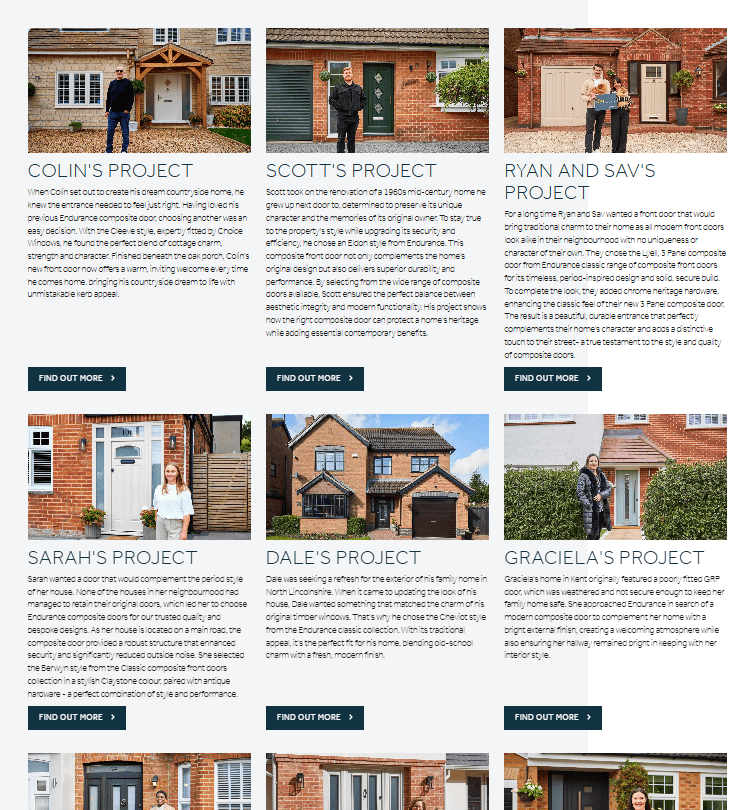
Link to more project examples
Below the examples should be a clear button such as:
See 12+ more front door installations
Numbers create powerful psychological signals.
Even if someone does not click the button, they will think:
“This company must install a lot of these.”
Only then explain more information about the product on the page
Once visitors have seen the examples of work done, which builds up more confidence in the company, they will be far more receptive to information about:
- Materials
- Energy efficiency
- Security features
- Colours and styles
- Guarantees
How Many Project Examples Should You Have?
The simple answer is:
As many as possible.
However, there are useful benchmarks.
Minimum expectations per product type:
| Level | Number of examples |
| Minimum | 6 |
| Good | 9 |
| Strong | 12 |
| Market-leading | 20+ |
If your website shows only one or two examples of each product type, visitors may assume you rarely do that type of installation, or don’t have many happy customers stories to tell.
Product Categories That Should Each Have Their Own Projects Examples
For typical windows, doors & conservatory installations companies, examples should exist for each sub-category.
For example:
Windows
- Casement windows
- Sash windows
- Bay windows
- Tilt and turn windows
Doors
- Composite doors
- French doors
- Patio doors
- Bifold doors
- Aluminium doors
Conservatories & extensions
- Lean-to conservatories
- Victorian conservatories
- Orangery installations
- Garden rooms
Each category should contain its own examples of work.
Why Testimonials Are Not Enough
Many companies rely heavily on testimonials.
While testimonials are helpful, they are much less persuasive than real examples.
Testimonials are also easy to fake.
A sentence like:
“Fantastic service, highly recommended.”
… does not carry much weight.
Project examples, including imagery on the other hand, show:
- Real houses
- Real installations
- Real outcomes
They are much harder to fabricate convincingly.
And they provide much richer detail.
What Makes A Good Installation Example?
A simple structure works best, incorporating imagery within the project description.
The type of property
Example:
A detached house in Canterbury with ageing timber windows.
The homeowner’s challenge
Example:
The existing windows were draughty and difficult to maintain.
The solution provided
Example:
We installed six white UPVC casement windows with energy-efficient glazing.
The outcome
Example:
The homeowner immediately noticed improved insulation and a much brighter interior.
Optional testimonial
If available, include the homeowner’s comments.
Example:
“Very impressed with the installation and the difference it has made to the house.”
What If Customers Don’t Want To Be Named?
Some people worry about confidentiality.
In practice, most homeowners are perfectly happy for photos of the work to appear online. They can even be part of your terms & conditions.
However, if necessary, case studies can be anonymous.
For example:
Semi-detached home in Whitstable
Or:
Victorian terrace in Kent
The key is that the installation is clearly on a real-life property.
The SEO Advantage Of Installation Project Examples
Large numbers of case studies set up as individual pages also bring a major SEO benefit.
Each project creates an opportunity for a page that includes:
- Location references
- Property types
- Product types
- Product styles
- Photos
For example:
- Bifold doors installation in Canterbury
- Replacement sash windows in Whitstable
- Composite front door installation in Herne Bay
Over time this creates dozens or hundreds of highly relevant pages, which search engines love.
Where Project Examples Should Live On Your Website
There are two main ways to structure them.
Option 1 – A central projects section
This is where they live, but summary excerpts are linked to them from your product pages.
Example structure:
/projects/windows/
/projects /doors/
/projects/conservatories/
Option 2 – Within each product category
Example:
/windows/casement-windows/project-1
/windows/casement-windows/project-2
/doors/composite-doors/project-1
Both structures work well.
The most important factor is that summary excerpts of the projects appear prominently on the product pages themselves.
Measuring The Impact Of Project Examples
The effect of installation examples can be measured.
Your website analytics can show:
- How many visitors view case studies
- Which product pages they came from
- Whether they later make enquiries
Many companies discover that a significant proportion of visitors click from product pages into examples of previous work.
Why This Matters Even More Today
The window and conservatory industry is extremely competitive.
Most homeowners compare multiple installers before making contact.
If one company’s website clearly demonstrates:
- 30+ front door installations
- 40+ window replacements
- 20+ conservatories
… while another company shows only a handful of images, the difference in perceived experience is enormous.
A Simple Exercise For Your Business
List every product you offer in a spreadsheet and then fill in the names of clients you’ve provided those products to, and that you could create case studies from.
For example:
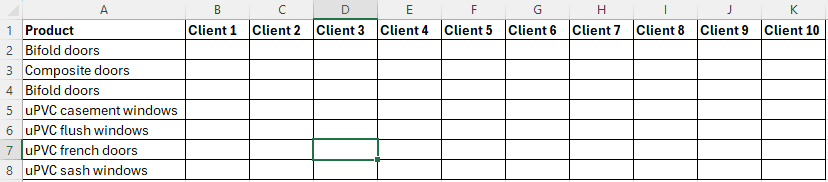
You may realise that you’ve completed far more projects than you realised.
Then it’s a case of starting to build up project installation pages for each client.
Don’t stop at 10 – go as far as you can – the more project examples you have, the more people will engage with your website.
The Real Reason Many Companies Don’t Do This
The biggest barrier is not lack of projects.
It is simply perceived lack of time to document them.
Yet even basic case studies – a few photos and a short explanation – can have a huge impact on enquiries.
Just to reinforce this point
If your website does not show enough examples of your work, homeowners will simply assume one of two things:
Either:
- You have not done many installations
or - You are hiding them
Neither impression helps your business.
The Businesses Winning More Enquiries
The windows, doors, conservatories businesses that win the most enquiries online usually share one characteristic.
Their websites show dozens or even hundreds of installations.
Every product page reinforces the same message:
“We do this all the time.”
That level of visible experience builds enormous trust.
And trust is what turns a website visitor into a homeowner making contact.
How To Convert Even More Of Your Website Visitors
Whether or not your website has enough installations examples to show your potential clients, those visitors are in the market to buy from you or your competitors.
In many cases, it’s possible to identify the house addresses of those website visitors looking for windows, doors, or conservatories, which gives you opportunity to combine plenty of your client work examples into a quality brochure/printed pack, and send them to those houses.
In fact, you can stand out significantly more than competitors because you know your website visitors have looked at multiple websites. If your great examples of work done land on their door mat a day or two after visiting your website, then that gives them something to flick through and share with others involved in the decision-making process.